
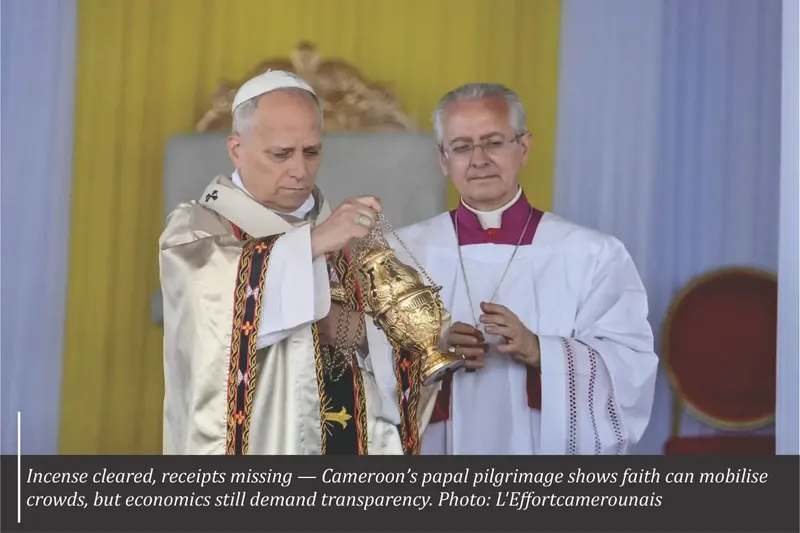
Two weeks after Pope Leo XIV’s whirlwind visit to Cameroon, the initial fanfare has subsided, and the true economic implications are coming into focus.
On the surface, the visit resembled a national holiday fused with diplomacy: a farewell Mass in Yaoundé reportedly drew 200,000 people; the liturgy at Bamenda’s airport attracted approximately 20,000 attendees; and Douala’s Japoma stadium Mass saw 120,000—a number far short of the 600,000 projected by organisers.
This disparity is crucial, as it hints at the multifaceted nature of the visit: not a single event, but a series of economic ripples—some uplifting, some exploitative, and most distributed unevenly. Why did he come? The Vatican stated the purpose clearly: in Yaoundé, the Pope called for “dialogue, fraternity, and peace.”
At the same time, he delivered a strong message on governance—urging an end to “chains of corruption,” advocating for “transparency in the management of public resources,” and emphasising youth investment as a foundation for peace.
The timing was no coincidence. Separatist groups called an extraordinary three-day truce for the Pope’s visit—a rare pause in years of conflict. When a ceasefire is tailored to a visit, a “pastoral visit” inevitably becomes a moment of strategic national intervention.
What did he bring? Global attention, a rarity for Cameroon’s ongoing crises. Bamenda became the emotional centre of the visit, with international media underlining the Anglophone conflict’s toll: over 6,000 deaths and more than 600,000 displaced since 2017.
The Pope’s speeches elevated governance, corruption, and peacebuilding onto the world stage. Yet local analysts now question whether the short-term calm will translate into longer-lasting change, or if the financial and social costs will ultimately outweigh the temporary spotlight.